NBC/Getty Images
Even in these days of hotter summers and disappearing traditions, a few fall rituals remain reassuringly predictable: back-to-school sales, postseason baseball, and the annual uproar over an offensive Halloween costume.
This year, it was Target's turn.
For generations, poverty among rural Southern whites had been treated not simply as an economic condition but as evidence of something wrong with the people themselves.
A screenshot circulating on social media showed a child model wearing a “circus clown” getup from the retailer's Hyde and EEK house brand. Critics said the face mask, miniature top hat, and gloves — not to mention the child's pose — evoked blackface and 19th-century minstrelsy. Target quickly pulled it.
The Rev. Jamal Bryant, the Georgia pastor who spent the previous year leading a boycott of Target over its retreat from DEI initiatives, called it “a profoundly harmful symbol of racism.” Target followed with a corporate apology: “As a company, we know we got this wrong, and we are deeply sorry. The costume is offensive and should never have been part of our assortment.”
The resemblance to Jim Crow-era imagery was vague enough to give Target the benefit of the doubt. The individual elements of the costume have lost enough of their original meaning that a designer could plausibly assemble them without recognizing that they once belonged to a caricature of a particular people.
But the cultural memory of minstrelsy remains strong enough that once the connection was pointed out, the resemblance was clear enough to make pulling it the right call.
We retain a similar sensitivity to the old caricatures of most ethnic groups, even when the stereotypes themselves have receded from everyday life. But there is one old American caricature that has become so detached from the people it once mocked that most of us no longer recognize it as an ethnic caricature at all.
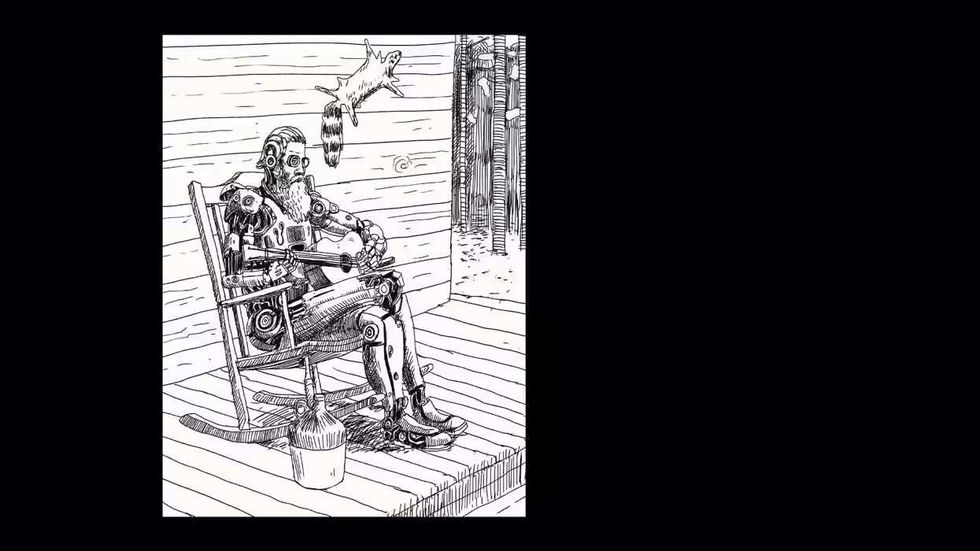
Walk into almost any big-box store or scroll online retailers this month, and you will find it: the frayed overalls, the missing front tooth, the corncob pipe, and a jug of moonshine. A quick Google search shows that “trailer park,” “redneck,” and “hillbilly” costumes abound. You can even dress as Joe Dirt, Ricky from "Trailer Park Boys," or Joe Exotic from "Tiger King."
No corporate statement has ever called such costumes “especially hurtful.” No brand has ever pulled any one of them and promised to look closely at how it happened. It's simply a costume built on the presumed backwardness, dirtiness, and moral degeneracy of the people once called “hillbillies,” sold with little awareness of the history behind the stereotype.
That history includes a largely forgotten mass migration — and the prejudice and discrimination that followed it. At roughly the same time that millions of black Southerners were heading north and west in the Great Migration, another vast movement was under way. Historian Max Fraser estimates that as many as 8 million whites left the Southern countryside for the factory towns and cities of the industrial Midwest, along what became known as the “Hillbilly Highway.”
And that was only part of a much larger exodus. Historian James Gregory estimates that nearly 20 million white Southerners left the South over the course of the 20th century, compared with close to 8 million black Southerners. Yet while the Great Migration became a familiar part of the American historical narrative, the parallel movement of white Southerners largely faded from national memory.
My own family were part of that migration, moving from Western Kentucky to Gary, Indiana, in the 1950s. They weren’t hillbillies, technically — Western Kentucky sits roughly 300 miles from Appalachia — but that distinction meant little once they got north. To the people already there, a Southern accent did all the sorting a map wouldn’t.
That the migration was remarkably successful seems hardly to have mattered. Chad Berry’s oral histories of the Southern whites who migrated to Midwestern mill and factory towns found that most achieved the economic stability they had sought, even as their new neighbors continued to stereotype them as violent, drunken, lazy, unclean, and sexually dissolute.
Richard Dorson captured the prejudice in "Land of the Millrats," his study of the industrial communities around Gary. Driving through nearby Whiting with a local man named Ed, Dorson was told why trailers carried a particular stigma: “This is a Southern white area. Hillbillies live in the trailers. So there's prejudice attached to trailers, 'cause that was the first housing available to Southern whites in the community. So trailer equals hillbilly.”
The prejudice could have more tangible consequences. Historian Anthony Harkins found that job listings announcing “No Southerners need apply” and restaurants refusing to serve “hillbillies” were not uncommon in Northern cities receiving Appalachian migrants.
RELATED: How My Hometown Got Eugenicized
 Gabriel Gigliotti
But the contempt those migrants encountered in the North had much older roots. For generations, poverty among rural Southern whites had been treated not simply as an economic condition but as evidence of something wrong with the people themselves.
In her book "White Trash," historian Nancy Isenberg traces that tradition from colonial descriptions of the poor as “waste people” through the antebellum contempt for the supposed moral failings of “poor white trash” and into eugenic theories that treated poverty and “feeble-mindedness” as hereditary defects.
Appalachian journalist James Branscome made this case explicitly more than 50 years ago, in a 1971 manifesto called "Annihilating the Hillbillly." By portraying Appalachians as backward, ignorant, and responsible for their own poverty, he argued, coal operators, government agencies, and the national media diverted attention from the economic arrangements that had enriched outsiders while leaving much of the region poor.
The hillbilly, in other words, provided a convenient explanation for poverty: The problem was the people. And when millions of those people left the rural South, found industrial work, and built more prosperous lives elsewhere, the stereotype followed them anyway.
Today the hillbilly survives mostly as a seemingly harmless comic trope. The caricature migrated from comic strips like "Snuffy Smith" and "Li'l Abner" to television's "Hee Haw" and "The Beverly Hillbillies." More recently it was "Here Comes Honey Boo Boo" and "Duck Dynasty." Cletus and Brandine Spuckler are still turning up on new episodes of "The Simpsons," more than 30 years after Springfield introduced its "slack-jawed yokel."
It might be harder to laugh if we still connected those characters to the people the caricature once described.
The history isn't particularly ancient. In 1958, Time quoted sociologists describing poor Southern whites as “vicious” and more difficult to assimilate than other minority groups. A Wayne University survey of Detroit residents published in 1952 found “poor Southern whites; hill-billies” the second-most frequently named group when residents were asked which people were “not good to have in the city.” Twenty-one percent named them, compared with 13% who named black residents; only “criminals and gangsters,” at 26%, ranked higher.
These were the people who left Eastern Kentucky and West Virginia for the mills of Gary and East Chicago and the auto plants of Detroit. They didn't bring backwardness north with them. They brought labor. Many found the economic security they had gone looking for and became part of the working class that built the industrial Midwest.
Eventually, they also became less visible. Their children and grandchildren lost the accents, left the trailer parks, moved into the middle class, and blended into the rest of America. The people disappeared into the country while the character remained behind.
That is the history the Halloween costume no longer evokes.
None of this requires another corporate apology. But corporate sensitivity reveals something in what it notices — and what it doesn't. Some old caricatures still carry a social cost. Others remain fair game.
I don't know what my own family heard when they migrated more than 300 miles north to Gary. They're gone now, and they didn't leave that part written down. That's part of the point. The costume survived. Their story didn't.