NurPhoto/Getty Images
Even the Washington Post, hardly a bastion of "Reefer Madness" hysteria, is sounding the alarm.
In a recent op-ed, former nurse Monica Romano described how heavy cannabis use beginning at age 13 led to years of addiction and anxiety. Romano acknowledges what an increasing body of research now suggests: Today's high-potency cannabis is linked to impaired memory, disrupted adolescent brain development, depression, and a heightened risk of psychosis. She thought marijuana would solve her problems. It didn't. If anything, it made them many times worse.
On average, cannabis use appeared in medical records roughly two years before psychiatric treatment became necessary.
That should give America pause. Instead, the country seems to be moving in precisely the opposite direction.
And Romano's story may become increasingly familiar as more young Americans are exposed to these products at an early age.
Eight percent of eighth-graders are already using cannabis. By tenth grade, that number doubles to 16%. By the time high school seniors are clearing out their lockers and preparing to disappoint their parents in the real world, roughly one in four have experimented with marijuana. Cannabis is now a mainstream feature of modern adolescence, right up there with slamming doors and threatening to run away from home.
What today's kids are consuming bears little resemblance to the weak, dirt-flavored twigs that hippies smoked while strumming out-of-tune guitars at Woodstock. Modern cannabis is a different beast entirely. It's stronger, meaner, and vastly more potent. If earlier generations were playing with matches, the kids of 2026 are playing with blowtorches.
A massive study published in JAMA Health Forum tracked almost half a million teenagers ages 13 to 17, following them into their mid-20s. Adolescents who reported cannabis use were significantly more likely to require psychiatric hospitalization later in life. The risk of psychotic disorders and bipolar disorder roughly doubled. The consequences can be devastating and lifelong.
The data came directly from pediatric health care records collected between 2016 and 2023. On average, cannabis use appeared in medical records roughly two years before psychiatric treatment became necessary. First comes the smoke, then comes the psychological fire. It is a grim progression that makes it increasingly difficult to dismiss these outcomes as nothing more than pre-existing vulnerabilities.
RELATED: 4 marijuana facts the pro-pot lobby doesn't want you to know
 Michael Ochs Archives/Getty Images
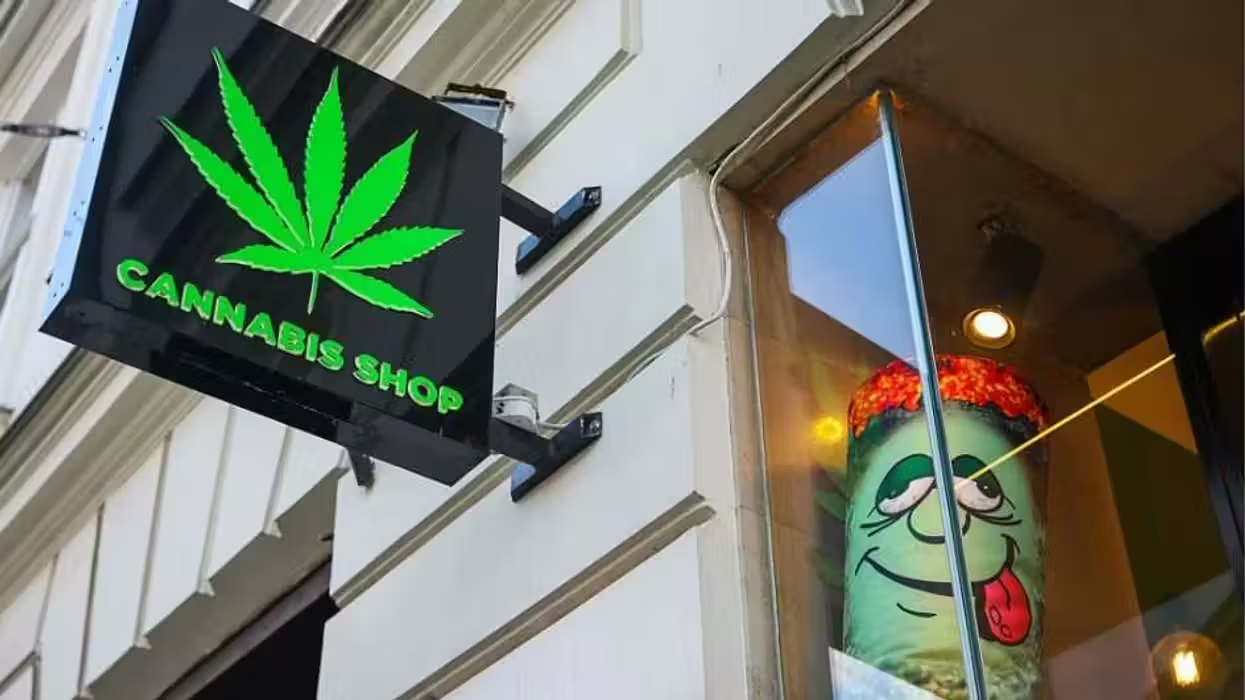
Regulators have allowed an increasingly potent drug to be packaged in brightly colored gummies, chocolates, and candies while permitting advertising features that researchers say make cannabis more appealing to adolescents. Recent research has found that flavor references, colorful illustrations, and other youth-oriented marketing cues significantly increase teenagers' interest in cannabis products, even in regulated markets.
It is a remarkably effective business model, assuming your future customers are also your future psychiatric patients. When a brain-altering substance becomes easier to buy, easier to market, and easier to normalize, the line between consumer product and public health problem begins to disappear.
Psychosis involves a profound break from reality. When a young person loses the ability to distinguish internal thoughts from the outside world, the foundations of an ordinary life begin to crumble. Individuals with chronic psychotic disorders face a suicide risk roughly 12 times higher than the general population. Beyond that lies the daily reality: maintaining relationships, holding a job, or living independently become dramatically more difficult.
The data spikes across the board, affecting more than just the hardcore stoners who wake up and immediately rip a bong before breakfast. The JAMA Health Forum study examined self-reported use in the past year. A casual, weekend puff at a party was enough to increase the odds of future madness. You don't need to be Snoop Dogg to shatter your mind; a little bit of casual experimentation will do the trick nicely.
Of course, not every kid who takes a hit will end up conversing with the toaster. Risk isn't destiny. But when you double the chances of permanent psychiatric damage, playing Russian roulette with a few extra chambers loaded starts to look like a terrible bet.
To understand why the kids are losing it, you have to look at the chemistry. A few decades ago, cannabis had a single-digit percentage of THC. Today, California flower routinely clears 20%, and the concentrates — the vapes and dabs — climb north of 95% pure, unadulterated psychoactive gasoline. America is handing industrial-strength chemical weapons to teenagers and acting shocked when their lives begin to fall apart.
A teenager's brain is still under construction. The neural circuits responsible for judgment, emotional regulation, and impulse control are being built in real time. Flooding those unfinished systems with extraordinarily potent psychoactive chemicals risks altering that development in ways that may not fully reverse. The consequences will echo well beyond adolescence: more impaired workers, more struggling students, greater mental illness, and a generation less prepared for the ordinary responsibilities of adult life.
The country spent decades arguing over whether marijuana should be legalized. That argument is largely over. The question now is whether America is prepared to live with the consequences of normalizing a drug dramatically stronger than anything previous generations consumed. Judging by the evidence, those consequences have already begun to arrive.