Celal Gunes/Anadolu/Getty Images
In Onondaga County, New York, a union has gone to court to stop an artificial intelligence tool from answering nonemergency calls at the county’s 911 center. The system handles routine calls, roughly a third of the center’s volume, and transfers suspected emergencies to human operators. The county wants to use the technology. The union wants it stopped.
The union contends that the rollout violates its labor agreement. But its lawsuit puts a familiar priority on display: Protect work covered by the contract, even when new technology might improve a public service.
Americans should not have to sacrifice the benefits of invention to preserve yesterday’s job descriptions.
Labor unions exist to defend their members. They owe no comparable allegiance to consumers, employers, or workers who never join. That last group is enormous. Union members accounted for just 10% of U.S. wage and salary workers in 2025 and only 5.9% in the private sector. Yet a union can use its bargaining power to obstruct changes that would benefit everyone else.
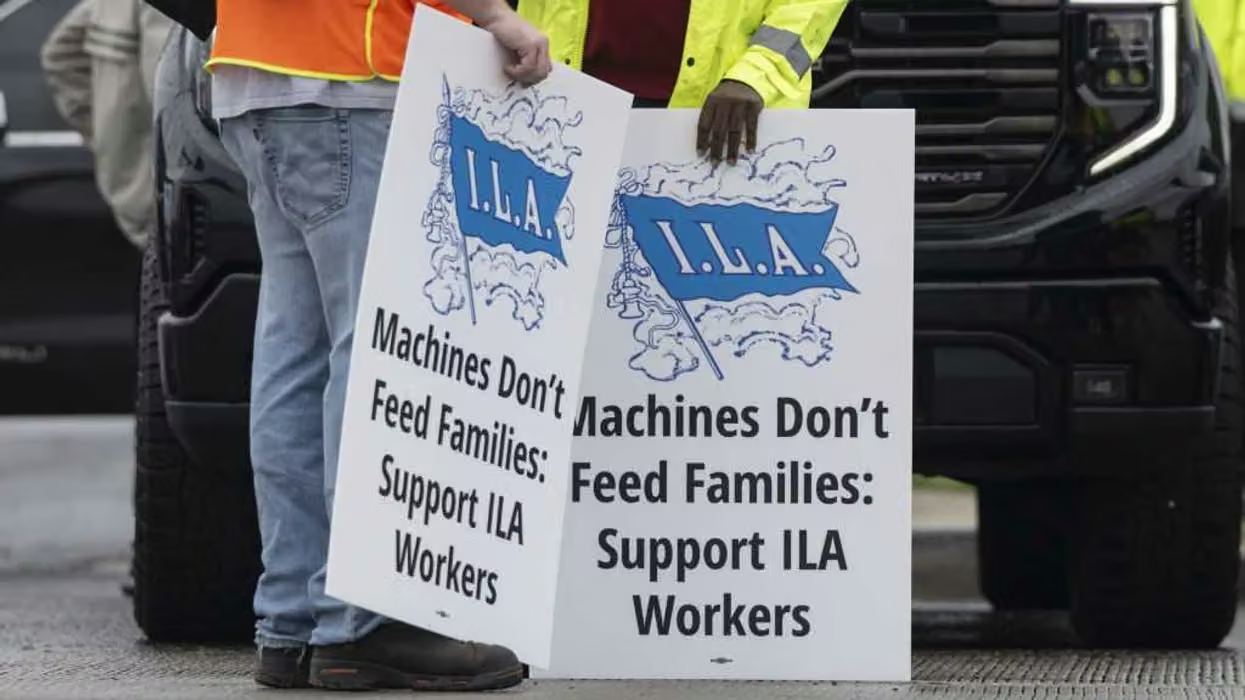
American ports offer a more expensive example. The 2025 Container Port Performance Index, which measures vessel turnaround efficiency, ranked only one U.S. port among the world’s top 50: Philadelphia, at No. 48. Meanwhile, the International Longshoremen’s Association has made opposition to automation a central demand.
The ILA’s 2025 agreement with employers at East and Gulf Coast ports delivered a 62% wage increase over six years. It also restricted automation. As Jordan McGillis reported in City Journal, employers must hire another longshoreman for every new semiautonomous crane they install, while fully autonomous cranes remain prohibited.
Better machines could move goods faster and reduce costs for businesses and consumers. The union secured limits on those machines instead. A Congressional Research Service report has also documented long-standing concerns about payroll fraud and organized crime influence involving the ILA on the New York-New Jersey waterfront.
RELATED: America doesn’t need Dario Amodei’s permission to build
 Jason Henry/Bloomberg/Getty Images
This struggle predates computers, robots, and artificial intelligence. Some medieval craft guilds protected their privileges by limiting competition and resisting techniques that threatened established trades. American unions have repeatedly followed that example.
When diesel locomotives displaced steam engines, railroads no longer needed firemen to tend boilers. Unions nevertheless fought to preserve those jobs. H.E. Gilbert, president of the Brotherhood of Locomotive Firemen and Enginemen, defended that struggle in 1963: “You can always mint more money. But you can’t mint new lives.”
Gilbert cared about the livelihoods of his members. He ignored the workers and families who would gain from cheaper, more efficient rail service. Protecting a job made obsolete by technology does not preserve the wealth that makes employment possible.
In 1971, the International Longshore and Warehouse Union staged a 134-day strike as containerization transformed shipping. The fight centered on jobs, jurisdiction, and work rules as machines replaced much of the labor once required to load cargo. In 1986, Rupert Murdoch moved his British newspapers to computerized printing at Wapping, dismissed 5,500 workers, and faced union picketing for more than a year.
RELATED: The future belongs to people who believe in one
 Cheng Xin/Getty Images
In each dispute, established workers fought to defend their position against technological change. The gains from new equipment, however, extended well beyond the employers who purchased it. Consumers gained faster service and lower costs; other workers benefited from a more productive economy.
Workers should remain free to join unions and bargain collectively. Voluntary labor organizations belong in a free society. But decades of government intervention have given organized labor legal privileges that can come at the expense of nonunion workers, employers, and customers. Those privileges deserve scrutiny, not automatic deference.
A union has every incentive to protect its members. The public has no obligation to make that protection the governing purpose of an industry or a taxpayer-funded service. The East India Company did not trade in a free market simply because it conducted commerce. Nor does a union bargain in a free labor market when government grants it advantages unavailable to everyone else.
Innovation raises living standards by allowing people to produce more with less. Organized labor can help workers adapt to that progress, or it can try to halt it. Americans should not have to sacrifice the benefits of invention to preserve yesterday’s job descriptions.