Miguel Perfectti/Getty Images
I recently traveled to Georgia to speak at an event. The trip out went smoothly. For the return, I arrived at the Atlanta airport early for a flight to Denver, then Bozeman.
That was the itinerary. The weather had prepared a competing proposal.
Back on the interstate, the bus lurched through every curve and pothole. By dawn, the airport was in sight. We perked up. Too soon.
Storms in Denver delayed us in Atlanta for an hour and a half. Once airborne, we took a longer route around the weather, only to learn that Denver was no longer an option.
We diverted to Grand Junction, which is not Denver.
I cannot blame the airline for the weather. Colorado has never shown much interest in coordinating its thunderstorms with commercial aviation.
In Grand Junction, we sat on the tarmac another hour awaiting news.
I will not identify the airline. I will only say its name rhymes with “reunited,” which none of us were with our schedules, connecting flights, or remaining optimism.
By the time a plan emerged, the pilots had timed out. Several flight attendants had timed out. Before long, most passengers had emotionally timed out as well.
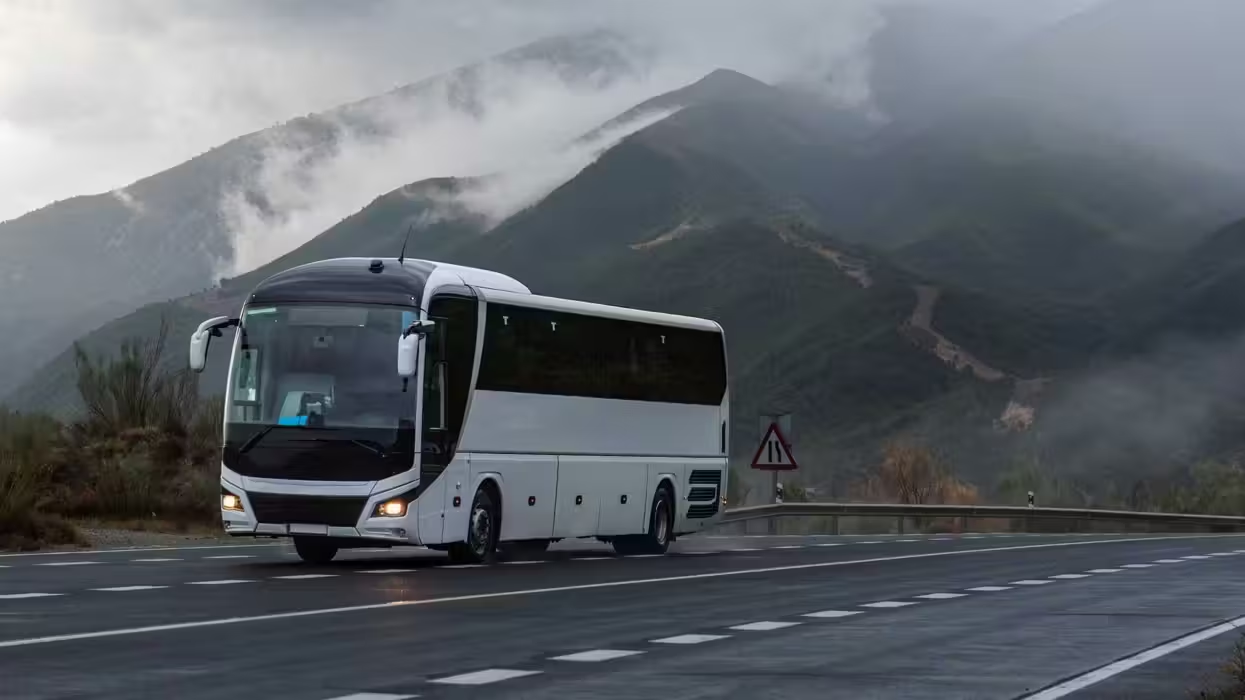
With no hotel rooms available, the airline announced that three buses would take us the nearly 250 miles to Denver.
On the bus, passengers offered plans for Denver. Someone suggested that we pray for the sweet embrace of death.
Granted, that passenger was me. But still, somebody said it.
Heading into the Colorado darkness toward the Rockies, there was a mild discussion about renaming ourselves the Donner Party.
Somewhere east of Grand Junction, our bus began breaking down. The driver limped into a gas station parking lot.
RELATED: What Montana taught this Southern storyteller about shutting up
 Karla Ann Cote/NurPhoto/Getty Images
We needed a replacement. We waited another hour and a half.
“Where are we?” someone asked.
“One of Dante’s circles,” I muttered.
The gas station sat beside a dark river that, by then, I could only assume was the Styx. I scanned the water for Charon. His ferry seemed more dependable than our bus.
Eventually, word came that another bus was being sent. We had started with three. Now a fourth was coming to our rescue.
“Oh yay,” I sighed. “The fourth bus of the Apocalypse.”
When it arrived, the absurdity developed a liability problem.
One passenger was a man with disabilities. Neither bus was accessible. Airport personnel had helped him onto the first, but at the gas station, we had no equipment and no trained crew.
Thankfully, my wife, Gracie, was safe at home in Montana. After 40 years of caring for her, I recognized the unspoken assumption: Exhausted passengers with no equipment would somehow transfer this gentleman.
But “we’ll figure it out” is not a safe plan.
One wrong move could have sent him or one of us to the emergency room, with a deposition to follow.
I called the local paramedics and asked for trained help. They eagerly arrived and got him safely onto the replacement bus.
Despite the sighs, dark jokes, and a smattering of words unsuitable for an airport announcement, nobody came to blows, left anyone behind, or became the star of an airport video.
When the transfer was complete, I told the paramedics to send the bill to the airline. While they were at it, they could add my consulting fee.
Back on the interstate, the bus lurched through every curve and pothole. By dawn, the airport was in sight.
We perked up.
Too soon.
At the airport, our driver hit the clearance sign warning that the bus was too tall. The sign, unlike most of the evening’s arrangements, proved accurate.
He backed away and found another way in. We could see the terminal. Several of us pleaded to walk.
One even whimpered.
OK, that was me too.
By then, it seemed the airport simply did not want us there.
RELATED: The myth of the ‘good person’
 Calvindexter/Getty Images
Inside, airline staff began sorting out missed connections. An agent was helping me when another came to the desk and said, to no one in particular, that a passenger was unhappy and she wasn’t going to deal with the person.
I don’t know what had happened between them. But after our night, I was surprised she’d found only one.
As Election Day approaches, I keep thinking about that gas station and a bus full of strangers.
Many people feel stranded, waiting for somebody who promised to get them where they need to go. Promises count, and people should be held to them. But at 2 o’clock in the morning, the man at risk could not wait for the people who had sent us down that road to reappear.
Our driver knew who to call for another bus. I knew who to call for trained help. The paramedics came. The rest of us waited when all we wanted was to get moving.
Strangers worked together, and the man came with us.
We can disagree about the route, the driver, and whose job it was to send the bus. When someone is at risk, we can still pull together, find help, and wait until everyone is aboard.
United was printed on our tickets.
By dawn, I knew the difference between putting it on a ticket and putting it into practice.